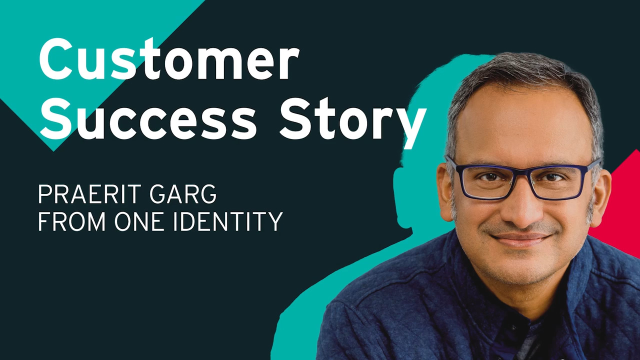
Welcome. I'm here with Praerit of One Identity, the new CEO. Welcome, Praerit.
Thank you, Martin. Thanks for having me.
I think we met recently already and had a bit of a conversation when you entered your new role. And it was interesting, because we ended up having a lot of commonalities in our past with you being at Microsoft. Not many people know I've been a freelance promoter and studying at the first land manager booth of Microsoft at CeBIT fair in Germany, and then following Windows NT and the Active Directory from basically more or less day one. So maybe you talk a bit about your own history in the industry.
Absolutely. Thanks, Martin. Like we talked about, I've been doing this for 30 years. I've been a software professional now for 30 years.
I started my career back at Microsoft in 1995 on what became the Active Directory when we launched with Windows 2000. And so it's kind of interesting to go back. When I originally started, we had a NT 3.51 release that was the land manager days. And you and I could connect back to literally 30 years ago using the similar stuff.
And still some of that stuff is around at the end of the day. At least technology wise, there are things which still exist. A bit ago, I've been talking to a CISO. So when we touch the OT security, he said he would be lucky if he only had the NTLM protocol to deal with. But he said, I even have the LM protocol around in my OT environment, so the operational technology.
Wow. [LAUGHS] Yes, you and I were sort of joking about this, that the security properties dialog in the File Explorer and in Active Directory is still the dialog that I designed back in the late '90s. So yeah, technology, even though we have come such a long way, there are some things that are still the same.
It's fun to be back in the identity space. For me, I feel like I've made a full circle, starting my career, being on the Active Directory team, building things like Kerberos and PKI infrastructure, and the access control model. Spending time at AWS, running a lot of their identity and security infrastructure teams over there. To then come as CEO of One Identity, where I've come a full circle in that regard.
Yeah. And you help right now organizations to manage the access controls on their still existing Windows file servers, where they then see the dialogue you've created almost three decades ago. So at the end of the day, it's really closing the circle here.
Totally feels that way. I also say to people that, in some ways, coming to One Identity is like finishing the job, some of the things that I couldn't do when I was on the Active Directory team. The full lifecycle management of identity from the point and employees hired into the organization into the HR system, to managing their access, the full identity governance across the application suite.
And then even the employee leaves sort of cleaning up and the attestation work around that. Or the privilege elevation capabilities that we offer with safeguards. So at One Identity, we're doing all the things that augment on top of the core directory capabilities. And so it's sort of finishing the job.
Yeah. And that's really great, because it means you're a very experienced, seasoned professional in this industry right now in a CEO role. And I dare to say you really understand what you're dealing with. So you also are working with us as an analyst firm. So why do you do it?
Well, Martin, you've built quite a practice, I have to say. I think you might remember Burton Group back in the '90s and early 2000s. Burton Group was this firm like yours, that specialized in the identity space. And when Burton Group got acquired by Bochner, there was really a gap created.
And I think you've gone and created KuppingerCole as a specialist analyst firm in this fairly complex and critical space for organizations. I have a lot of respect. You've done an incredible job. The firm is so well respected in the world now as an expert in this space. I think customers need your expertise. So that's why I think our partnership, and I've only learned coming back into the space at One Identity how critical of a role you play, and your team plays, in helping us and customers to be successful in this space.
Yeah. And the market didn't become easier to handle. We see a lot of new emerging technologies. The number of vendors has grown massively. I remember back when we started, someone said, why do you do something for 50 or 80 companies out there? Right now we have significantly more. We have very, very well settled large players like One Identity, and also still a lot of evolution and movement in the market. And I think, yes, it definitely didn't become simpler to navigate through that world than it was two or three decades ago.
Yeah, I think it's gotten more complex and it has gotten more critical. One of the evolutions that has happened is, as more and more organizations have moved into the cloud and have adopted SaaS applications, the network perimeter has essentially evaporated. There isn't a network. No organization can just say, oh, I can put a network firewall and I can protect myself. Identity has become the security perimeter.
When you look at the attack vectors now, phishing and spear phishing, the identity is the target now. Especially privileged accounts have become that target where that's how attackers are trying to get inside the networks and inside customer environments and breach. So I think your role has become even more critical. And we, as one of the vendors, are playing an important part of helping customers be protected. But you looking at the industry and helping customers look at all the options they have, it's a critical role.
Yeah. And I think one of the things we try really to do is to educate about more modern strategies on what to do and how do you do it right? Because I think one of the challenges every customer, more or less, has-- except a few newborn organizations-- is that you never act in a green field. You always have some legacy and you need to navigate them.
The simple answer of rip and replace never works well. I think it's usually can you evolve from here, and also build on all the experience and learnings when the spring was. And I think this is a very important thing in a fast evolving market where, at the end of the day, still you need a rock solid foundation in IGA, in access, in PAM to succeed in your cybersecurity posture.
Yeah. Martin, I just flew back from London over the weekend and met with one of our largest customers there. And it was actually quite humbling, Martin. They have hundreds of Microsoft Active Directories that they need to protect. They have thousands of Unix and Windows systems in their environment, and all of them have these privileged accounts.
So they are a Safeguard customer. And they are moving all those accounts onto Safeguard, because they want to control access to these privileged accounts like the root credentials, or the domain admin credentials. And in their environment, they keep finding more things that they need to protect. And each one of these can become a vector into the environment.
And if you don't do your homework, your baseline security, your hygiene, all that stuff, well, then you fail. I think that's the point. I think it's important then to look at what is going on, how are things evolving.
And I know your flagship product, One Identity mantra. I've known it for decades, way before the company was acquired by One Identity. And it has evolved over the decades with the needs in the market.
But there's still a substantial area of things that always remain the same. We started with the file dialog. And at the end of the day, there are things which just don't disappear and you need to do this as good as you do the modern stuff.
Very true.
All right, anything you'd like to add before we close?
No. Thank you for giving time to me, Martin. I'm looking forward to partnering with you as I settle in this role. I think your guidance is going to be key to how we continue to succeed and serve our customers. So I really appreciate it, Martin.
Thank you, Praerit, for taking the time. Pleasure always to talk to you, especially because both of us are definitely amongst the veterans in the industry.
Yes, we're definitely the veterans. Thank you.
Thank you.

 10:54
10:54